
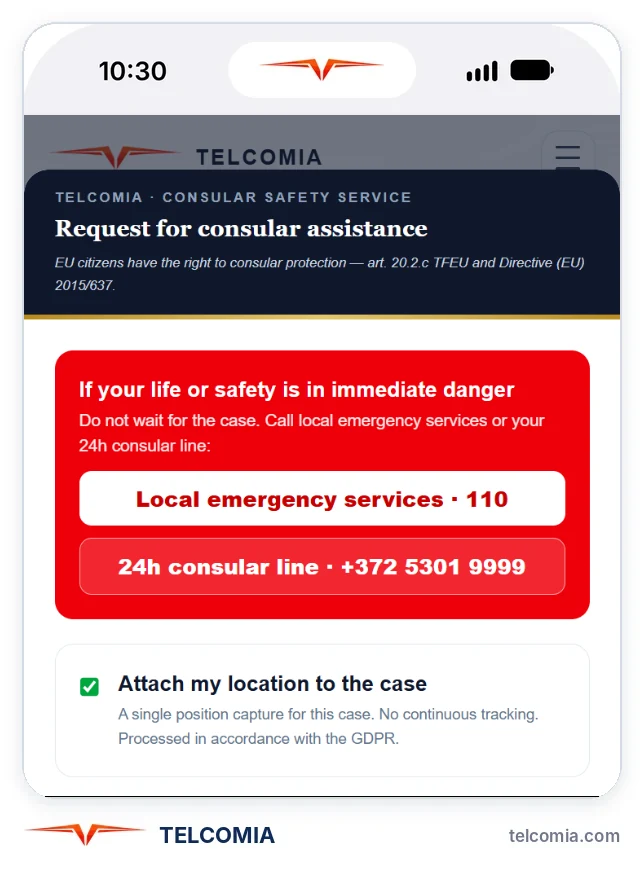
If your life or safety is in immediate danger, do not wait for the case: call the country's emergency number or your country's consular emergency line, which answers 24 hours a day. When you open the case, before you register it, Telcomia shows you both numbers (the consular line, if your country has one).
For everything else (a robbery, an arrest, a lost passport, a medical problem or a question), Telcomia prepares your request for help to your embassy, with your details. This guide explains what it does, step by step, and what right you have if you are an EU citizen and your country has no embassy where you are.
First, if you are in danger
- Call the country's emergency number. You will find it in your Telcomia account, under Safety, and in the safety guide for each country. If your eSIM is data-only, dial the number as a normal call.
- Or your country's consular emergency line, which answers 24 hours a day, if your country has one. It appears when you open the case, before you register it.
- Once you are safe, open the case so your embassy has in writing what happened.
What Telcomia does
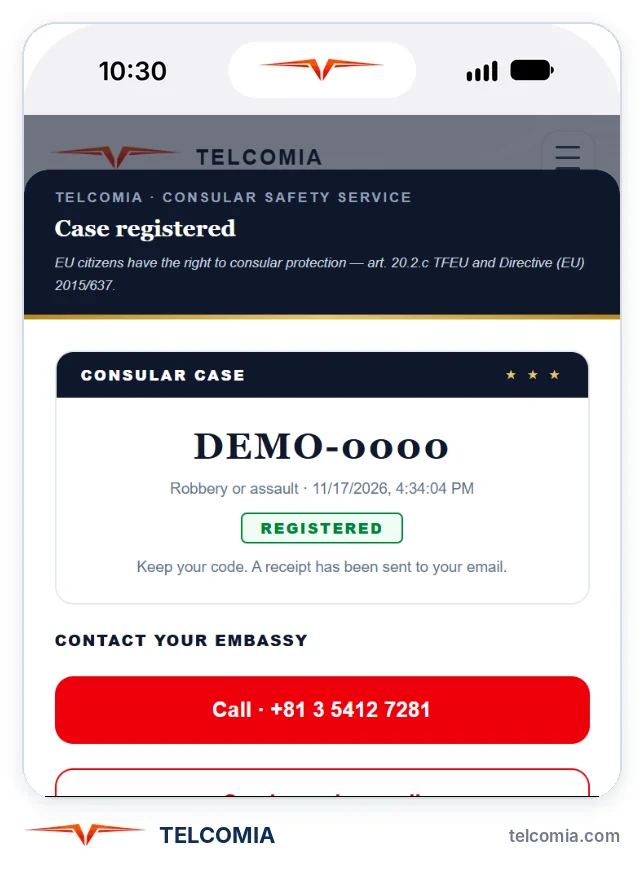
Telcomia records your case, gives you a case code and emails you a receipt. It then prepares the email to your embassy, with the code and the case details: you check it and send it yourself, from your own address. The embassy replies to you.
Once the case is registered, you also have the embassy's phone number to call and, if it has an address, directions to get there.
Step by step
- Sign in to your Telcomia account, open Safety and choose your eSIM's destination.
- Under "Emergency consular assistance", tap Request consular assistance.
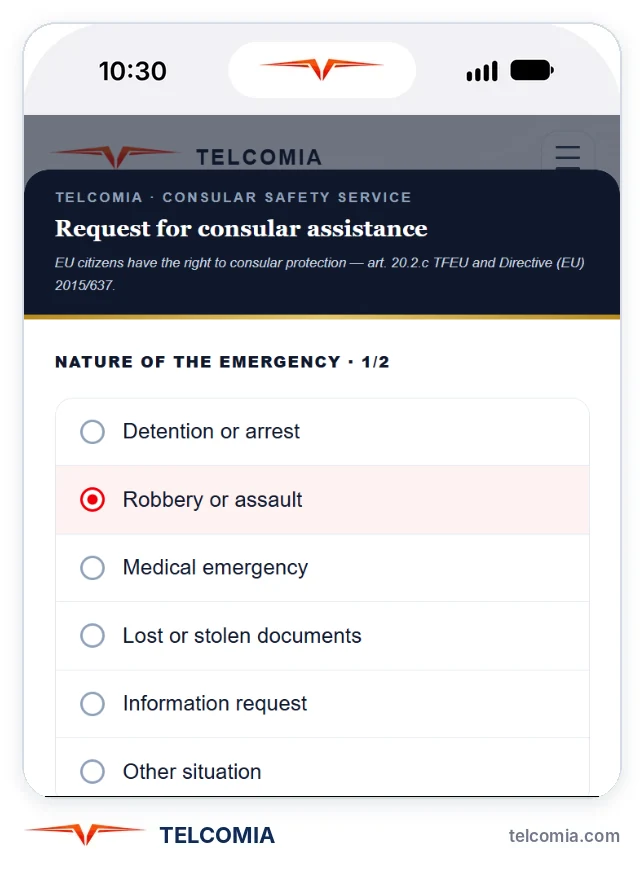
- Choose what happened: detention or arrest, robbery or assault, medical emergency, lost or stolen documents, information request or other situation.
- If you like, describe what happened in a few lines.
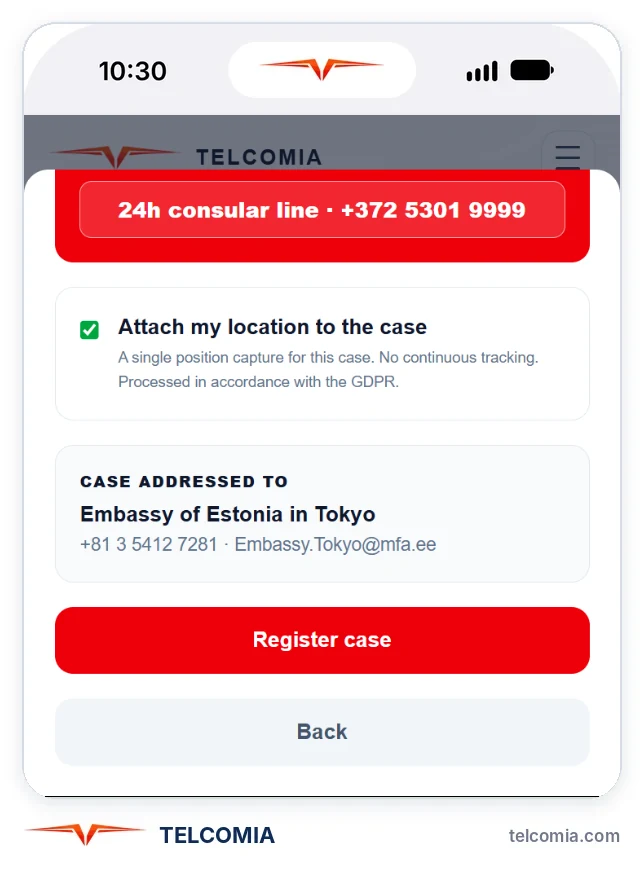
- In the next step you will see the numbers for an emergency. Decide whether to attach your location: it is a single capture of your position for this case, with no tracking.
- Check which embassy the case is addressed to and tap Register case.
- Keep the code. You also get a receipt by email.
- Tap Send case by email. Your email app opens with the subject, the code and the case details already written. Check it and send it.
For consular assistance to appear, you need an eSIM for that destination and your nationality set under Safety: that is how we know which embassy is yours. Only one case can be open per trip; if you already have one, you will see it.
What your embassy can do
Each country decides how it helps its citizens abroad. Usually it can issue an emergency travel document if you lose your passport, help you contact your family, give you lists of lawyers, doctors or translators, and visit you if you are arrested. It cannot pay your bills, get you out of prison or intervene in a trial. We explain it in detail in What Can My Embassy Do for Me Abroad?
If you are an EU citizen and your country has no embassy there
Outside the European Union, if your country has no embassy or consulate in the country you are in, or none that can help you in your case, you can ask the embassy or consulate of any other EU country for help. It must help you on the same conditions as its own citizens. This is set out in Articles 20(2)(c) and 23 of the Treaty on the Functioning of the EU and developed by Directive (EU) 2015/637.
The directive lists, among others, these situations: arrest or detention, being a victim of crime, a serious accident or serious illness, death, relief and repatriation in an emergency, and the need for an emergency travel document.
In the safety guide for each country you can see which consulate serves you for your passport. And in EU Consular Protection When Your Country Has No Embassy we explain it in more detail.
Have to hand
- A copy of your passport, on paper and on your phone.
- The local police report if you have been robbed: many embassies ask for it before issuing an emergency travel document.
- Your travel insurance details, if you have a policy, especially if the problem is medical.
Questions about emergency consular assistance
Does the case replace calling emergency services?
No. If your life or safety is in danger, first call the country's emergency number or your country's consular emergency line.
Does Telcomia send the case to my embassy?
No. Telcomia records the case, gives you the code and the receipt, and prepares the email. You send it from your own address and the embassy replies to you.
What is in the email?
The subject with your case code, what happened, your description if you wrote one and your location if you attached it. You can check and change it before sending.
Is my location shared?
Only if you choose to attach it: it is a single capture of your position for that case, with no continuous tracking.
Which embassy is it addressed to?
Your country's embassy in your destination, based on the nationality you set under Safety. You see which one before you register it.
What if my country has no embassy in that country?
If you are an EU citizen outside the EU, you can go to the embassy or consulate of any other EU country, which must help you as it would its own citizens (Directive (EU) 2015/637). The safety guide for each country shows which consulate serves you.
How much does it cost?
Telcomia's consular assistance is free, included with your eSIM. Some embassy services, such as an emergency travel document, may have their own fee.
Can I open more than one case?
Only one can be open per trip. If you already have one, you will see it when you go in.
Keep reading
Ready to stay connected without surprises?
Activate your eSIM in seconds and travel connected in 200+ countries and territories.
See plans