
Greece is inside the EU's Roam Like at Home: with a plan from Spain, France or Italy you pay the same as at home, unless your phone latches onto a network in Turkey or Albania, which you can see from several islands. And in Greece you need your phone for the whole trip: ferry tickets live on your phone, timetables change with the wind and, in summer, wildfire alerts arrive through 112.
This guide starts with what matters if something goes wrong (who to call, where your consulate is and what governments say) and moves on to the practical side: what your phone does in Athens, on the ferry, on the islands facing Turkey, on Corfu and in the mountains of Crete, which laws surprise tourists and how to stay online for the whole trip.
Consular protection: if something goes wrong
Is Greece safe to visit right now?
The Telcomia Safety Index for Greece is 1/4 (Low risk, level 1 of 4) as of Nov 22, 2026. It is a composite of official advisories from Spain, the United Kingdom, the United States and Germany, recalculated daily.
69 diplomatic missions from 65 countries, across 6 cities.
Situation now·
Greece: Athens trending for the holidays, strikes and protests
Athens is the top trending international destination in Google Flights searches from the US for Christmas and New Year 2026, and the Bank of Greece reported inbound travellers in December 2025 up 49% on a year earlier. The US keeps Greece at Level 1 (exercise normal precautions), noting that large demonstrations can occur with little notice. The UK warns that terrorists are likely to try to carry out attacks (on 1 July 2026 incendiary devices against the homes of political figures killed one person), that there is a heightened risk of protests in central Athens, that strikes called at short notice can disrupt buses, trains, ferries and flights, and that thefts are common on the metro. On 2 November Storm Agneta brought torrential rain and flash flooding to Rhodes: residents received an emergency alert around 03:30, and at least 60 vehicles were swept away by the floodwater. Greece's meteorological service (EMY) issued an orange warning for the Dodecanese, the Ionian islands and Epirus, since lifted, and on 3 November the UK updated its advice to warn of severe winter weather, including storms and flash floods (The Independent, 3 November).
What governments advise
Check with your airline or ferry company for strikes, keep your passport and wallet secure on the Athens metro and move away from protests. The emergency number is 112.
What to do
- 1Before travelling by ferry, train or plane, check for strikes.
- 2Keep your passport and wallet secure on the metro and in central Athens.
- 3Move away from demonstrations, especially around the main squares of Athens.
- 4Allow emergency alerts on your phone so you receive Greece's 112 warnings about floods, storms and earthquakes.
- 5In an emergency call 112.
- 6With a Telcomia eSIM for this trip, your embassy's details, the risk level and the emergency phrases with audio stay saved on your phone and open even without a connection.
Questions travellers are asking this week
Is it safe to travel to Greece right now?
Yes. The US keeps Greece at Level 1 (exercise normal precautions). The UK warns of a heightened risk of protests in central Athens and of strikes that can disrupt transport.
Is Athens safe right now?
Yes, with the usual care: thefts are common on the metro and in crowded places, and demonstrations take place around the main squares, according to the UK.
Will strikes affect my trip to Greece?
They might. Strikes are regular and sometimes called at short notice, affecting buses, trains, ferries and air travel, according to the UK. Check with your transport provider.
How the Telcomia app helps
- Your embassy and its emergency numbers, one tap away.
- An alert if the risk level rises during your trip.
- Everything saved on your phone to read offline.
- Emergency phrases in the local language, with audio.
- Mobile data from the moment you land, so alerts reach you.
Sources: blog.google (Oct 5, 2026) · bankofgreece.gr (Feb 24, 2026) · United Kingdom — Foreign Office (FCDO) (Aug 11, 2026) · United States — Department of State (Oct 22, 2025) · independent.co.uk (Nov 3, 2026)
A dated summary of official and press sources. It does not replace instructions from the local authorities or your embassy.
- Phone (from a mobile): 112 works for any emergency; 100 is the police, 166 the ambulance, 199 the fire service and 108 the coast guard, for any emergency at sea.
- Tourist police: 1571 helps tourists 24 hours a day in several languages; Spain notes that it works from Greek numbers.
- Your embassy: almost all are in Athens, and some countries also have a consulate in Thessaloniki or on the larger islands. The Telcomia app shows you yours, with address and phone number, and emergency phrases in Greek, with audio, to show on screen.
- If your country has no embassy or consulate in Greece and you are an EU citizen, the embassy of any other EU country must help you on the same terms as its own citizens (Article 23 of the Treaty on the Functioning of the EU).
- Lost or stolen passport or ID card: go to the police as soon as you can. Spain explains that in Greece a theft report opens a criminal case and takes hours, while a declaration of loss is quicker and many airlines accept it to fly you home; check with yours. If you have no other document, your embassy can issue an emergency travel document. See which consulate serves you by passport in the Greece safety guide.
- A document you reported lost and then found is no longer valid: Spain warns that you will not be allowed to board a plane or a ship with it, and that on a cruise calling at Turkey or Montenegro the police will confiscate it. Get a new one before you travel.
- Carry your documents: the UK says to carry your passport at all times and warns that the police may not accept a copy; Spain recommends carrying the original or a copy. Keep a photo of the document on your phone as well, stored separately.
- Official alerts: Greece sends emergency alerts from 112 to every phone in the affected area, in Greek and English; they also tell you if you need to evacuate. Germany recommends keeping them switched on in your phone's settings. Civil Protection posts warnings at civilprotection.gov.gr, and the fire service at @pyrosvestiki.
What governments say
Checked on 20 November 2026.
- The United States asks for normal precautions in Greece (level 1 of 4). It warns that petty crime is common in tourist areas and that large demonstrations can happen at short notice and disrupt transport.
- The United Kingdom does not advise against any area. It warns that terrorists are likely to try to carry out attacks, that strikes called at short notice stop buses, trains, ferries and flights, and that passports and wallets are stolen on the metro and in central Athens.
- Spain places no restrictions on travel to Greece and lists no areas to avoid. It asks for care after dusk around Omonia and Metaxourgio squares, on public transport and in the busiest parts of central Athens, and at demonstrations in Syntagma Square.
- Germany has no travel warning for Greece. It warns of frequent pickpocketing in Athens, Thessaloniki and Piraeus from April to November, especially on the metro and on the airport buses, and of wildfires in summer.
Demonstrations tend to recur every year on 1 May, 17 November and 6 December, mainly in central Athens. On those days, check transport before you go out and keep away from the crowds.
Getting in: documents, checks and money
- With an ID card or passport: Spaniards only need a valid DNI, and other EU citizens their national identity card. Spain recommends travelling with both and keeping them apart: if you lose one, you go home with the other.
- From outside the EU: Greece is in the Schengen area. With a British or US passport, for example, you can stay 90 days in any 180-day period without a visa, counting all Schengen countries together.
- The new border system (EES): non-EU travellers may have their fingerprints and a photo taken at the border the first time, and the queue can be longer. The ETIAS authorisation is not running yet; the EU plans to launch it in the last quarter of 2026.
- Cash: you must declare 10,000 euros or more at customs; the UK advises asking for a stamped copy of the declaration, because without it the money can be held when you leave.
- From the islands to Turkey: on day trips to Bodrum, Marmaris, Kuşadası or Çeşme you leave the Schengen area and the EU. Carry the passport or document Turkey asks for based on your nationality, and remember that EU roaming does not cover you there.
The essentials
The European Commission sums it up like this: Roam Like at Home applies in EU countries, in the European Economic Area (Iceland, Liechtenstein and Norway) and in Moldova and Ukraine. Greece is included, so with an EU plan you call, text and use data at home prices, within your operator's fair use limit.
The change comes when your phone connects to a non-EU network without you leaving Greece: it happens on the coasts of Kos, Rhodes, Samos, Chios and Lesbos, which face Turkey, and in the north of Corfu, opposite Albania. And on the open sea, some ships have their own network, billed separately.
Does my plan work here?
- With an EU plan: yes, as at home. Check how many gigabytes your plan gives abroad, because some operators set a lower limit than at home.
- With a plan from the UK, the US or another country: there is no regulated roaming. Your operator may charge a daily fee in the EU; check the price before you leave.
- If your phone is old: check that it supports 4G calling (VoLTE) when roaming; if not, data may work and calls may not. Ask your operator.
- If you install a data eSIM, turn off data roaming on your usual line: that way your phone does not use data from your plan without you noticing, and you still receive calls and texts on your number.
Where you are and what your phone does
| Where | What can happen | What to do |
|---|---|---|
| Airports (Athens, Thessaloniki, Heraklion) | With an EU plan, nothing changes; with a non-EU plan, roaming starts charging as soon as your phone connects to a Greek network | Have the eSIM installed before you fly and turn it on when you land |
| Athens: the metro, Plaka and the Acropolis | Good 4G and 5G coverage, also on the metro; on the airport metro and in the busiest areas there are pickpockets | Keep your phone on the inside and your Acropolis tickets already downloaded |
| Piraeus and the ferries | In port and near the coast, a Greek network; on the open sea the signal disappears, and the ship may offer its own network, billed separately | Download your ticket before you reach the port and turn off data roaming on your line during the crossing |
| Kos, Rhodes, Samos, Chios and Lesbos | On the coast facing Turkey, your phone can connect to a Turkish network, outside EU roaming | Choose a Greek network manually and check the network name before you use data |
| Northern Corfu | Opposite Albania, your phone can connect to an Albanian network, also outside EU roaming | Choose a Greek network manually; if you go to Sarandë, check that your plan includes Albania |
| Crete: gorges and mountains | Inside gorges such as Samaria and on mountain roads there are long stretches with no signal | Offline maps, water, a power bank and someone who knows your route |
| The northern border | On the Evros, facing Turkey, and near Albania and North Macedonia, your phone can switch to a non-EU network; these are also military areas | Choose a Greek network manually and do not photograph military installations |
Athens
From the airport, the metro and the express bus reach the centre, and taxis can also be booked with apps such as Uber or Free Now, which send licensed cabs. Buy tickets for the Acropolis and the museums online and keep them on your phone: in high season the queues are long and entry is by time slot.
Before you get on a bus or train, validate your ticket at the machine: Spain warns that inspectors carry out checks and that the fine can reach 60 times the basic fare. And in restaurants, the law requires them to give you an itemised bill: ask for it.
The islands and the ferries
Ferry operators send e-tickets that you show on your phone, and timetables can change with the wind or a strike, sometimes at short notice. Before you go to the port:
- Download the ticket and keep a screenshot, in case there is no signal at the quay.
- Check for changes on the operator's website or app, especially when the meltemi blows in summer or there are storms in winter.
- During the crossing, turn off data roaming on your usual line: the ship's network usually runs over satellite and is billed separately.
- Respect red flags on the beaches, don't dive where you don't know the depth and, for water sports, choose licensed centres and ask how to call for help.
In bars and clubs, Spain and the UK warn that drinks are sometimes spiked: keep your glass in sight; the UK adds saving your accommodation's address on the map and going back with someone.
The islands facing Turkey
Kos, Rhodes, Samos, Chios and Lesbos are a few kilometres from the Turkish coast. In the harbours and on the eastern beaches, your phone can jump to a Turkish network without you leaving Greece, and on an EU plan that is charged as outside the EU. Choose a Greek network manually in your phone's settings and look at the network name before you use data.
If you take the day trip to Turkey, there you do need non-EU data: your EU plan does not cover it, and neither does a Greece-only plan. What to know before you cross is in the Turkey internet guide.
Corfu and the Albanian border
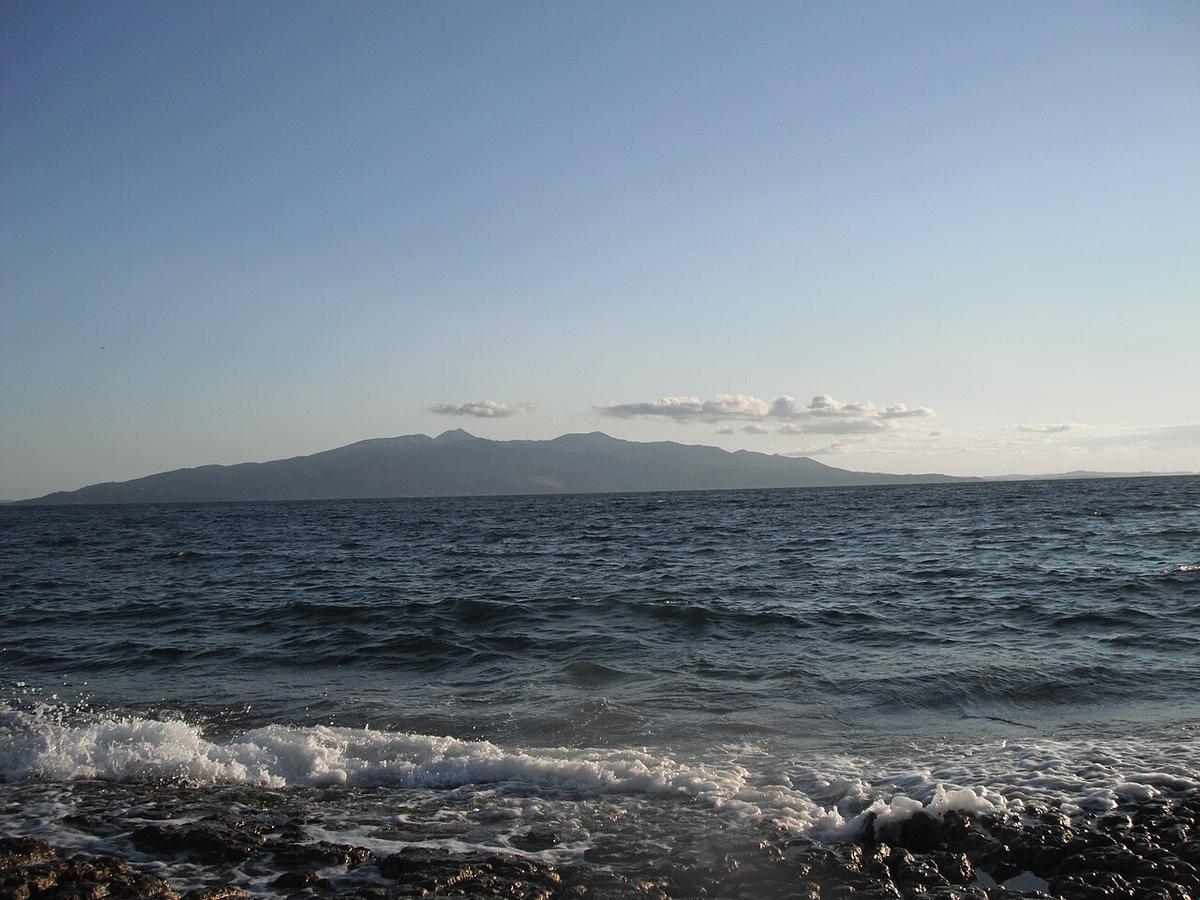
The north of Corfu faces the coast of Albania, and from Kassiopi or Agios Stefanos your phone can connect to an Albanian network. Albania is not in EU roaming. If you take the boat trip to Sarandë, see the Albania internet guide.
Heat, wildfires and earthquakes
In summer, Greece often goes above 40 degrees and the wildfire risk is very high; fires change direction with the wind and close roads, including in tourist areas. From August to November there can be severe storms, with flooding. And Greece sits in a seismic zone: earthquakes are frequent.
- Keep emergency alerts switched on on your phone and follow the 112 instructions if you receive one.
- When hiking, set off early, carry plenty of water, a charged phone and a power bank, and tell someone your route. If you get lost, call 112: Germany points out that this lets them locate you.
- Don't light fires in the countryside: as well as dangerous, it is illegal because of the wildfire risk.
- Check the fire risk map that Civil Protection publishes every day in season, from 1 (low) to 5 (emergency).
Laws that surprise people
- Stones and antiquities: don't take anything from an archaeological site, not even a small stone. Taking antiquities out of the country without a permit can end in prison.
- Photos of military areas: it is forbidden to approach military installations or take photos and videos of them, and Germany adds that airports and ports may not be photographed either; EU citizens are prosecuted too. Don't fly your drone near these areas.
- Weapons: pepper spray, knuckledusters and knives with a blade of 10 cm or more count as weapons.
- Drugs: cannabis too is punished with prison and heavy fines, even in small amounts.
- Behaviour: the police arrest people for rowdy or indecent behaviour, especially when alcohol is involved, and some fancy-dress costumes can be considered offensive.
- Camping: you cannot camp or leave a motorhome on beaches, coastlines, forest edges or archaeological sites; use licensed campsites.
- Hitchhikers at Patras and Igoumenitsa: carrying someone without papers in your car, even unknowingly, is punished as people smuggling. Before boarding for Italy, check your vehicle.
Money and health
- Payments: cards are accepted almost everywhere, but some small shops and villages prefer cash. Always ask for a receipt.
- Driving: Spain reminds you to carry your valid physical licence; the DGT's digital version is not accepted. The British category P licence is not valid for mopeds in Greece.
- European Health Insurance Card: bring it (or the GHIC if you are British), but it does not replace travel insurance. On the islands care can be limited and an ambulance can take much longer than on the mainland.
- Medicines: Spain explains that you can bring up to 5 different medicines, at most 2 packs of each, in their original box and with a prescription. Some, such as codeine or diazepam, are controlled substances and may need prior permission.
- Mosquitoes: Germany warns that in 2026 there are more cases of West Nile fever than in other years; use repellent.
How to get connected
- A travel eSIM is installed at home with a QR code and, on most plans, starts counting when it first connects in Greece; each plan states before you pay when it starts. It uses Cosmote, Vodafone or Nova, depending on the plan, with 4G and 5G where available. It gives you data, not a Greek number: your usual number stays on your phone for texts and bank codes. If you are going to Turkey or Albania, a regional plan that names them lets you keep a single eSIM.
- With an EU plan, the eSIM makes sense if your plan gives few gigabytes abroad or if you are staying on an island facing Turkey.
- Wi-Fi in hotels and cafés works as a backup, but it doesn't come with you on the ferry, on the beach or in the mountains.
What consular protection comes with the Greece eSIM?
Consular protection included: the country's risk level based on official travel advice from the US, UK, Germany and Spain; nearby embassies and consulates on a map; 16 emergency phrases with audio in 41 languages.
When should I activate my Greece eSIM?
Each plan shows before you pay when it starts counting. Plans that start on connection start counting the first time they connect to a network in one of the countries they cover: install the eSIM before you leave, keep the line off until you arrive in Greece, and you'll have data as soon as you land. Some also work in other countries (each plan lists which): if the line connects earlier, at home or on a layover, it starts counting there. Plans that start when you buy them are best bought on the day you'll start using them.
How do I install and activate the eSIM?
After you pay, you get an email with the QR code within minutes. Scan it while your phone is connected to the internet, from Settings → Mobile Data → Add eSIM. When you arrive, choose the eSIM as your data line and turn on data roaming for it.
Do I keep my own phone number?
Yes. The eSIM adds a data line for Greece while your usual SIM and number stay active for calls and texts.
Questions about internet in Greece
Does my EU plan work in Greece?
Yes, with Roam Like at Home, at the same price as in your country and within your operator's fair use limit.
Why was I charged roaming on Kos or Rhodes?
Because near the Turkish coast your phone can connect to a network in Turkey, which is outside EU roaming. Choose a Greek network manually.
What is the emergency number?
112 for any emergency; 100 for the police, 166 for an ambulance, 199 for the fire service and 108 for the coast guard. For tourists, 1571.
Do I need a passport to go to Greece?
Spaniards and other EU citizens can travel with their valid identity card. From outside the EU, you need a passport.
Will my phone work on the ferry?
Near the coast, yes, on Greek networks. On the open sea the signal disappears, and the ship's own network is billed separately.
Do 112 alerts reach a foreign phone?
Yes, if it is connected to a Greek network and emergency alerts are switched on in the settings.
Which networks does a Telcomia eSIM use in Greece?
Cosmote, Vodafone or Nova, depending on the plan, with 4G and 5G where available.
Can I take a stone from an archaeological site?
No. Removing any object from an archaeological site is forbidden and can be punished with prison.
Next destination
Photos
- Corfu seen from the coast at Sarandë, in Albania. — NestedLoops, CC BY-SA 4.0
Ready to stay connected without surprises?
Activate your eSIM in seconds and travel connected in 200+ countries and territories.
See plansCompare Greece eSIM prices: Telcomia, Airalo, Saily and Holafly →