

Is it safe to travel to your destination? Each government answers with its own travel advisory, in its own scale and its own words, and they do not always agree. The Telcomia Safety Index brings them together in a single level, from 1 to 4, for almost 200 countries, and it is recalculated daily.
This guide explains what each level means, which advisories it comes from, where you see it and how to use it before and during your trip. And if you are in danger right now, you do not need to check any level: call the country's emergency number.
The four levels
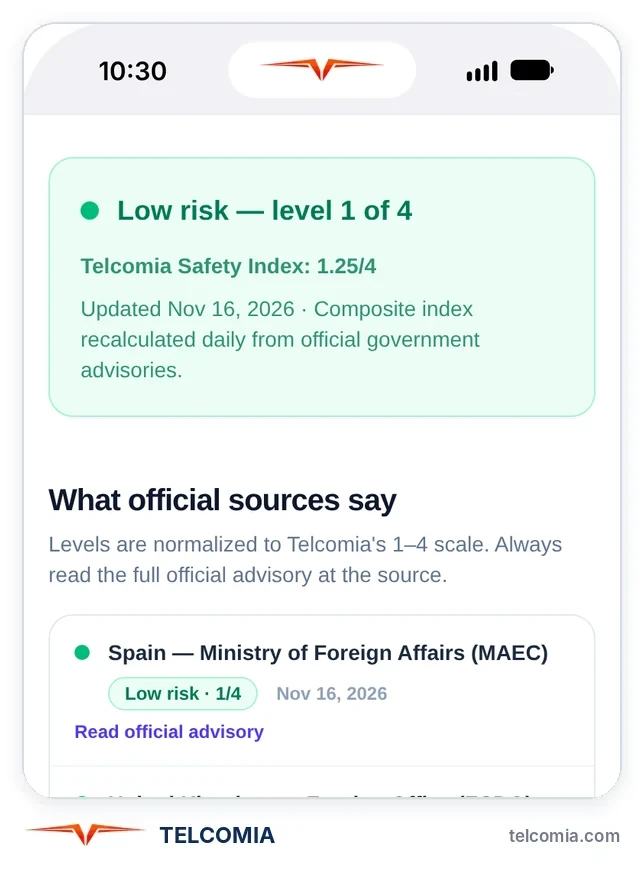
The index gives each country a level from 1 to 4, the same one you see on its safety page:
- Level 1 · Low risk. Yes, low risk overall: the precautions of any trip are enough.
- Level 2 · Increased caution. Yes, with extra caution: the advisories point to specific risks, such as petty theft, demonstrations or areas best avoided.
- Level 3 · High risk. Only if essential: the advisories ask you to reconsider travel or advise against all but essential travel, to the whole country or part of it.
- Level 4 · Do not travel. No, do not travel: the advisories advise against all travel to the country.
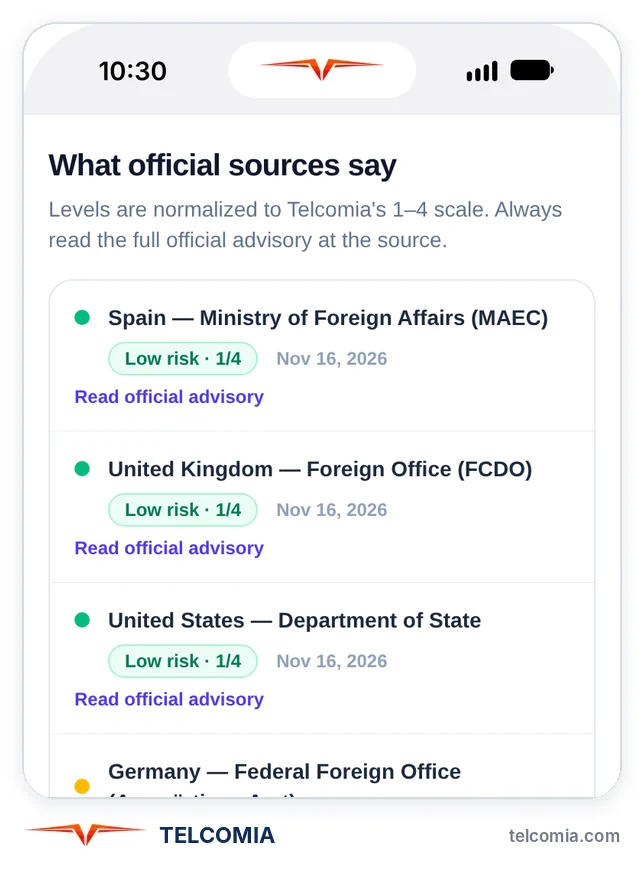
Next to the level you will see a score with decimals, for example 1.25 out of 4. It fine-tunes the level: the higher it is, the closer it is to the next one. Japan had 1.25 on 16 November 2026: Spain, the United Kingdom and the United States placed it at level 1, and Germany at level 2.
Where it comes from
The index combines the official travel advisories of four governments:
- Spain: Ministry of Foreign Affairs, European Union and Cooperation (MAEC).
- United Kingdom: Foreign, Commonwealth & Development Office (FCDO).
- United States: Department of State.
- Germany: Federal Foreign Office (Auswärtiges Amt).
Each one has its own scale. The Department of State uses four levels, from normal precautions to do not travel. The UK Foreign Office advises against all travel, or all but essential travel, to the whole country or part of it. Germany keeps its travel warning (Reisewarnung) for the most serious cases and uses partial warnings for specific areas. Spain recommends caution or, in the most serious cases, not to travel.
Telcomia brings each advisory to the same 1-to-4 scale and combines them into a single level. Only up-to-date advisories count: if a source has no advisory for a country, the index is calculated with the others.
On each country's page you can also see what each government says, with its level, its date and the link to its full official advisory. Read it: the areas, the dates and the entry requirements are there.
Where you see it
- On the safety page for each country, open to anyone: the level, what each government says, the risk areas, the emergency numbers and the embassies.
- During your trip: if the level of your eSIM's country rises, we let you know by email and, if you turn it on, on your phone. It is part of travel protection, free, included with your eSIM.
In your Telcomia account, under Safety, you also see the official advisory for your destination with the government that issues it: your own government's, if you are from Spain, the United Kingdom, the United States or Germany.
How to use it before you travel
- Check the level and the date for your destination.
- Read your own government's advisory, even if it is not one of the four sources. It is the one your embassy follows and often the one your travel insurance looks at: some policies do not cover you if your government advises against the trip. Check yours.
- Look at the areas, not just the country. A country at level 2 can have areas that governments advise against, and one at level 3 can have quiet areas.
- Sign up for your country's traveller registry, if it has one. That way your embassy knows you are there if something happens.
- Save the numbers: the country's emergency number and your country's 24-hour consular emergency line.
What the index is not
- It does not replace your government's official advisory, or the instructions of the local authorities or your embassy.
- It is not a forecast. It sums up what official advisories say today, and the situation can change quickly.
- It does not describe every area. It is one level for the whole country; the detail by area is in the advisories and on each country's page.
Questions about the safety index
How often is it updated?
It is recalculated daily with the latest advisories from the four sources. Each country's page shows the date of the last update.
Why these four governments?
They publish travel advisories for almost every country in the world, openly, and update them often.
My government says something different. Which one should I follow?
Your government's. The index combines four advisories, and yours may be stricter or more relaxed. For your embassy and your travel insurance, the one that counts is your own country's.
What does the score with decimals mean?
It fine-tunes the level. A 1.25 is still level 1, although not every government places it the same way.
Why does the level in my account not match the index?
Because in your account, under Safety, you see the advisory of one specific government, and the index combines all four.
Will you let me know if the level rises?
Yes, during your trip, if the level of your eSIM's country rises: by email and, if you turn it on, on your phone. We explain it in the travel protection guide.
Does it cost anything?
The safety pages are open to anyone. The alerts during your trip are part of travel protection: free, included with your eSIM.
Does the index take areas within a country into account?
The level is for the whole country. The risk areas and situations that official advisories point out are on each country's page.
Keep reading
Ready to stay connected without surprises?
Activate your eSIM in seconds and travel connected in 200+ countries and territories.
See plans